YouTube for Logistics and Cargo: How to Get Clients Through Video Marketing
Logistics, cargo, and freight forwarding are niches where trust builds slowly, sales cycles are long, and competition is driven by price wars. YouTube works differently in this context than banner advertising or cold calls. It establishes expert status, warms up your audience, and creates a constant stream of inbound inquiries-if you build the right strategy.
Who Should Use YouTube in the Logistics Niche
Video marketing on YouTube is relevant for a wide range of market participants:
- transportation and freight forwarding companies;
- warehouse complexes and fulfillment operators;
- manufacturers of specialized equipment, spare parts, and machinery;
- customs brokers and lawyers in foreign trade;
- supply chain management consultants;
- logistics business owners and industry experts.
The pain points are familiar: clients can’t see inside your processes, the value of your service is hard to explain in words, the market competes on price, and most leads arrive cold. YouTube addresses all of this directly-through demonstration, education, and consistent audience warming.
Basic Content Strategy: Hero, Hub, Help, and Shorts
Google offers brands entering YouTube a universal content model-Hero, Hub, Help (sometimes called Help, Hub, Hero). For logistics, it works particularly well because the business is multifaceted and easily divided into segments.
Help-Videos for Search Queries
This is the foundation of your channel. One search query, one video. People searching for information about logistics, customs, or cargo find your content in both YouTube search and Google search. It’s an evergreen format: a video shot today will still drive traffic a year from now.
That said, a Help video isn’t a destination-it’s a hook. The goal is to catch someone at any stage of the funnel and pull them further in, toward your series content.
Hub-Series Content by Topic
If your business covers multiple segments-international shipping, warehouse logistics, customs clearance-each one gets its own playlist. Someone arrives through a search video, then goes deeper into a thematic series. Hub content is what keeps people subscribed and coming back.
Hero-Content for a Broad Audience
Live streams answering questions, collaborations with other experts, documentary-style “from start to finish” formats-all of this expands reach beyond your already-loyal audience. For logistics, videos showing real processes work especially well: how cargo travels from sender to recipient, what happens at customs, how a warehouse operates inside.
Shorts-Viral Reach and Search
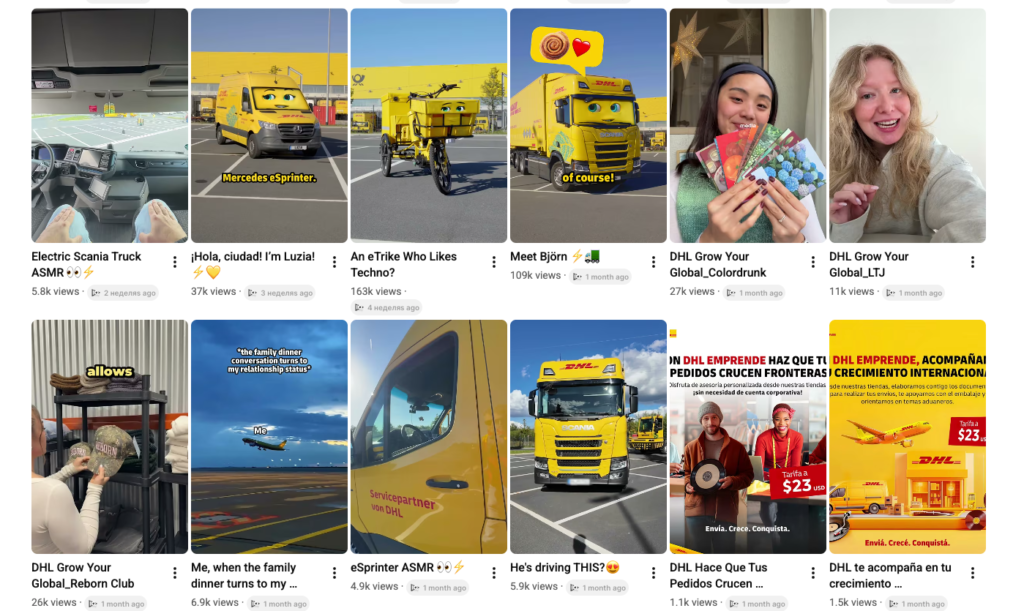
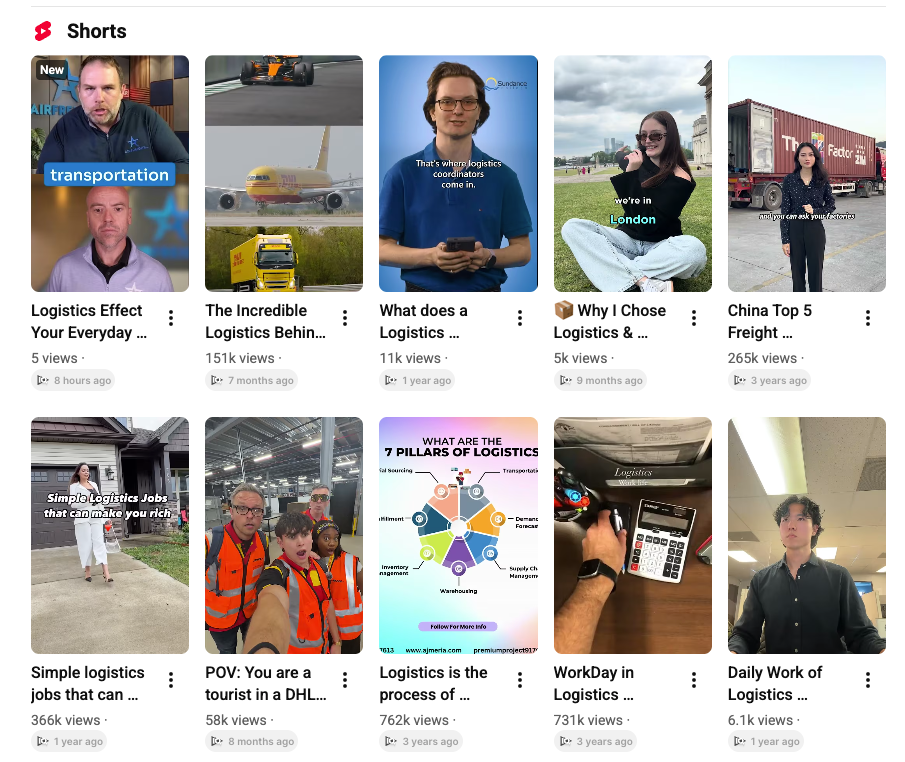
Short vertical videos participate in search, gain subscribers who then watch longer content, and spread organically well. For logistics, these could be dynamic shots of terminals, warehouses, and equipment in action-anything visually impressive that fits in 30-60 seconds.
The Funnel: From View to Deal
A typical funnel for a logistics company on YouTube looks like this:
- Shorts with dynamic infrastructure footage capture initial attention.
- Cross-linking leads to long-form videos-detailed warehouse tours, complex case breakdowns, educational guides.
- From long-form content, the audience moves to your Telegram channel or submits a rate quote request.
- Closing happens through an online meeting or webinar for potential and existing clients.
Those who watched content but didn’t convert go into a retargeting database. You then run paid ads with a specific offer-and they arrive at your landing page already warm.
Five YouTube Promotion Strategies
1. Organic Channel Growth
Minimum pace: 4 full-length videos and 15 Shorts per month. Optimal pace: 8 videos and 30 Shorts. The difference matters: if competitors have been running channels for years, catching up at minimum pace will be difficult.
Once you hit your first thousand subscribers, add monthly live streams. Direct interaction retains your audience and builds a community that actually looks forward to new content.
Based on experience with real projects, payback periods range from 3 to 6 months. First results typically appear by the end of the second or third month. Some projects break even by the sixth video; complex B2B niches may take slightly longer.
2. Personal Brand Development and Blogger Collaborations
If your company owner or key expert isn’t ready to run the channel independently, there’s another path. Find bloggers who already have the right audience. Your company representative appears on their podcasts, live streams, or collaborative videos. Content is published on the blogger’s channel-and works with an already-loyal audience.
3. Advertising Integrations with Bloggers
You don’t need your own channel at all. Select relevant bloggers and agree on placement terms-pre-roll, mid-video integration, or full collaboration where the entire video features your brand. Optimal ad length is 20 seconds to 1 minute, preferably in the first three minutes. Effectiveness is tracked and ROI calculated.
4. Multi-Platform Content Strategy
For companies with multiple target audiences or product lines. Create a 4-6 minute content-advertising video for each segment: client pain point, amplification, solution, case studies, expertise. Pair it with a series of short vertical videos leading to this main video.
Short videos can feature a real speaker, a virtual avatar, or be completely faceless-depending on your resources. The key is that this same content, without modification, is published on Instagram Reels, Facebook, TikTok, and other platforms. One production pipeline covers your presence everywhere.
5. Paid YouTube Advertising
For those who need leads right now. Most competitors advertise on Google and Meta-but YouTube as an ad inventory remains underutilized. The reason is simple: creating quality ad video is harder than making a banner. But that’s exactly why there’s less competition and lower cost per contact.
The setup is straightforward: a script written for a specific audience, an ad video, targeting the right segment, and a landing page with a clear offer. The result is inbound inquiries without waiting for organic growth.
What Content to Shoot
These formats work well for the logistics niche:
- infrastructure tours-warehouses, terminals, specialized equipment;
- breakdowns of complex logistics cases and routes;
- educational guides-customs, documentation, carrier selection;
- comparative analysis-rates, timelines, terms;
- interviews with industry leaders;
- industry news and trends;
- product and process demonstrations.
For short videos, the first few seconds have to earn attention immediately-and every second after that needs to deliver something useful. For long-form content, what matters is depth, high watch time, and a clear next step for the viewer.
Video Design: What Works
Thumbnails and titles determine whether people click. For logistics, these work well: an expert’s face with clear emotion, high-contrast readable text, comparison elements, and visualization of client pain points. Corporate style should be standardized-this builds channel recognition.
Competition and Channel Types in the Niche
Among expert and educational channels, competition is moderate: major players gain 50-300 thousand subscribers at a pace of 2-4 long videos per month. Corporate channels and B2B podcasts are low-competition zones, with most not exceeding 50 thousand subscribers at 1-4 videos per month. This means entering the niche and claiming a notable position is significantly easier now than it will be in two or three years.
Risks and Limitations
The logistics niche has specific constraints: YouTube’s content policy compliance requirements, possible restrictions on advertising certain services, and risk of shadow bans for aggressive claims. This isn’t a reason to abandon a channel-but it is a reason to build content policy carefully from the start.
How to Structure Content Production
Nearly every company faces the same questions: what to shoot, who appears on camera, where to shoot.
For the speaker: it could be the owner, a top manager, or a selected employee. If no one is willing to appear on camera, there are three options: completely faceless content, a corporate blogger as the channel’s face, or a virtual avatar with cloned voice.
For location: an in-office studio, a rented studio, or a mobile production crew. Each option works; the choice depends on budget and production pace.
For scripts: reading from a full written text looks unnatural on camera. Thesis-based anchor scripts work better-video structure, key content blocks, and calls to action that move viewers toward the desired next step.
Editing is one of the main levers for holding attention. Early videos in particular should be reviewed against audience retention benchmarks before you lock in a production routine.